

Sedimentary Refuge: Islamic Hijra and Refugee Camps in Amman
(Book Manuscript, Work in Progress)
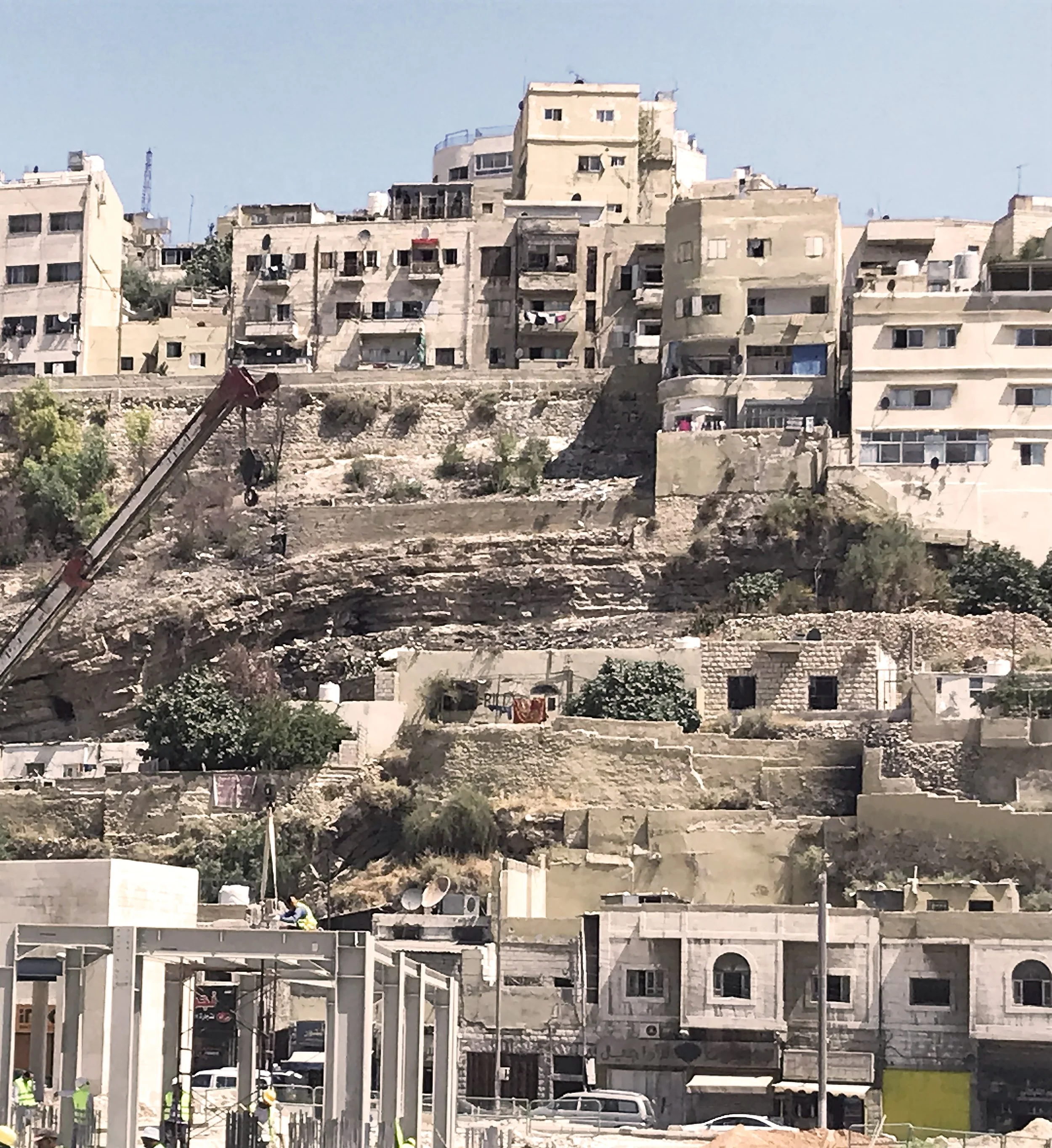
Sedimentary rock and architectural layering in Amman. Source: Author, 2019.
Contrary to dominant narratives that position the refugee camp and humanitarian aid at the center and beginning of modern refugee history, this book uncovers an architectural history of refuge structured by Islamic hijra (migration) and transformed through the global transplantation of the camp, which has sedimented, layer upon layer, in Amman’s built environment. Drawing on more than ten years of interdisciplinary archival and ethnographic research, it traces refugee histories from late nineteenth century Ottoman muhajirs (refugees) to 1948 Palestine refugees and up to post-2011 Syrian refugees. In doing so, this book challenges dominant scholarly views that either confine refugees to camps or trace the origin of refugee history only to humanitarian camps. It also critiques the common categories (of refugee, camp, and crisis) through which forced migration is rendered legible, especially in the Middle East. It does so by shifting the focus from camps to Islamic migration and Arab cities, and by adopting a sedimentary theory of space and time. Overall, by narrating a layered, sedimentary history of refuge, the book reveals, on the one hand, how Islamic hijra structured the spatial experiences of Muslims and Arabs, continuing to exert its influence on how they relate to the camp; on the other hand, how the humanitarian camp has fundamentally altered the scope, scale, and concept of Islamic hijra.
Research for this book manuscript has been supported by national and international fellowships and grants, including a Mellon/ACLS Dissertation Completion Fellowship, a Global Urban Humanities-Townsend Fellowship, an IJURR Foundation Studentship, a Critical Refugee Studies Grant, a Human Rights Fellowship at UC Berkeley School of Law, and grants from the Center for Middle Eastern Studies and the Institute of International Studies at UC Berkeley.